Savitsky Museum
The 'Louvre of the steppe': banned avant-garde canvases, Karakalpak jewelry and archaeology, hung with almost defiant confidence.
Tip · Take the guided tour — the collection's survival story is half the experience.
The far west, unfiltered
A banned-art museum at the edge of the map, desert fortresses, and the sea that walked away.
Nukus is the capital of Karakalpakstan, the autonomous republic that fills Uzbekistan's arid west — and the unlikely custodian of one of the 20th century's great art stories. In the 1960s, a collector named Igor Savitsky used this remoteness as a vault, quietly amassing tens of thousands of banned Soviet avant-garde works while the same canvases were being destroyed elsewhere.
The result — the Savitsky Museum — sits improbably among the concrete blocks of a desert administrative town, holding the world's second-largest collection of Russian avant-garde art. People fly across the world for these rooms, and they are right to.
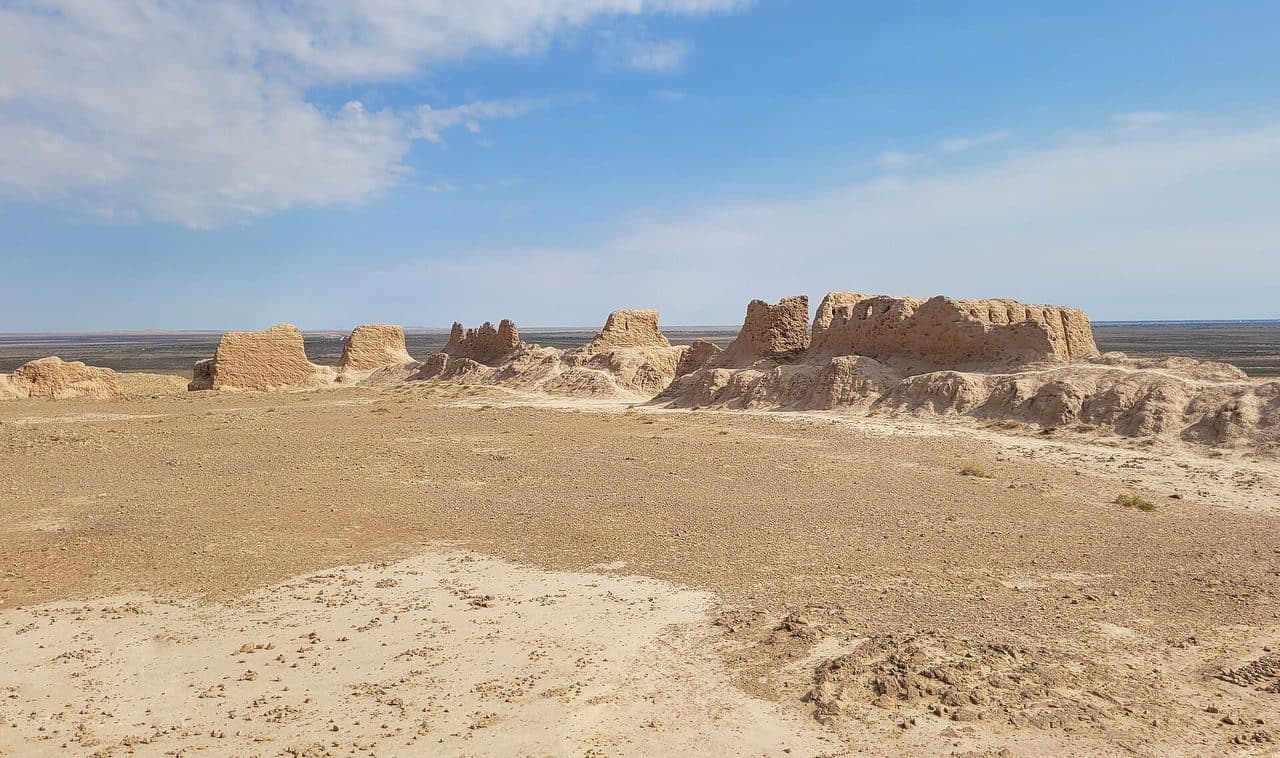
Around Nukus, the land tells harder stories. The Amu Darya delta once fed the Aral Sea; the fortresses of ancient Khorezm — Ayaz-Kala, Toprak-Kala — still stand on their desert bluffs after two thousand years, and Moynaq's fishing fleet rusts on a seabed that is now a hundred kilometers from water. It is the most affecting day trip we operate.
Worth your hours
The 'Louvre of the steppe': banned avant-garde canvases, Karakalpak jewelry and archaeology, hung with almost defiant confidence.
Tip · Take the guided tour — the collection's survival story is half the experience.
A 4th-century BC citadel on a desert escarpment, its mud walls still shoulder-high to history. The view across the Kyzylkum is the definition of empty.
Tip · Late afternoon light turns the walls copper; bring water regardless of season.
The palace city of ancient Khorezm's kings — throne rooms and fire temples legible in the clay two millennia on.
Tip · Combine with Ayaz-Kala in one fortress loop from Nukus or Khiva.
Trawlers beached on the former Aral seabed, a cliff-top town that lost its sea. Sobering, unforgettable, important.
Tip · The small museum's before-photos make the walk among the hulls land harder.
A hillside of mausoleums and legends outside Nukus, layered from Zoroastrian times to yesterday.
Tip · Golden hour, on the way back from Moynaq.
For the committed: a full-day 4×4 run across the seabed to the surviving, impossibly blue western basin.
Tip · Nine hours of driving — worth it once, and only with a desert-fit vehicle and driver.
At the table
The practical truths
Go properly